 Oshili Power
Somewhere in your business there is a line for what electricity will cost in the first year of trading, and in the piece before this one we argued that the line was set in the calmest year the grid has had in a decade. This piece is about the document that will arrive to replace it. When the wholesale market opens, many large power users in South Africa will be offered a supply contract by somebody: the utility, a municipality, a generator, a trader, or a retailer that did not exist last year. The offer will use words you already know. Energy. Capacity. Firm. Interruptible. Pass-through. It will look like a tariff with a new letterhead, and the five questions below are the places where it is not.
What arrives
A bundled tariff today does one thing well: it hides the shape of the risk inside an average. Energy in every hour at one price, a network and demand charge, a line for levies, and the cost of keeping the lights on at seven in the evening spread across all of it. The market separates those things by design, not by accident. The transmission company trades in its own name. The wholesale market has a licensed operator. The regulator has moved the independent power contracts from the utility to the transmission company as counterparty. Each of those steps takes a cost that used to arrive as an average and gives it a line of its own.
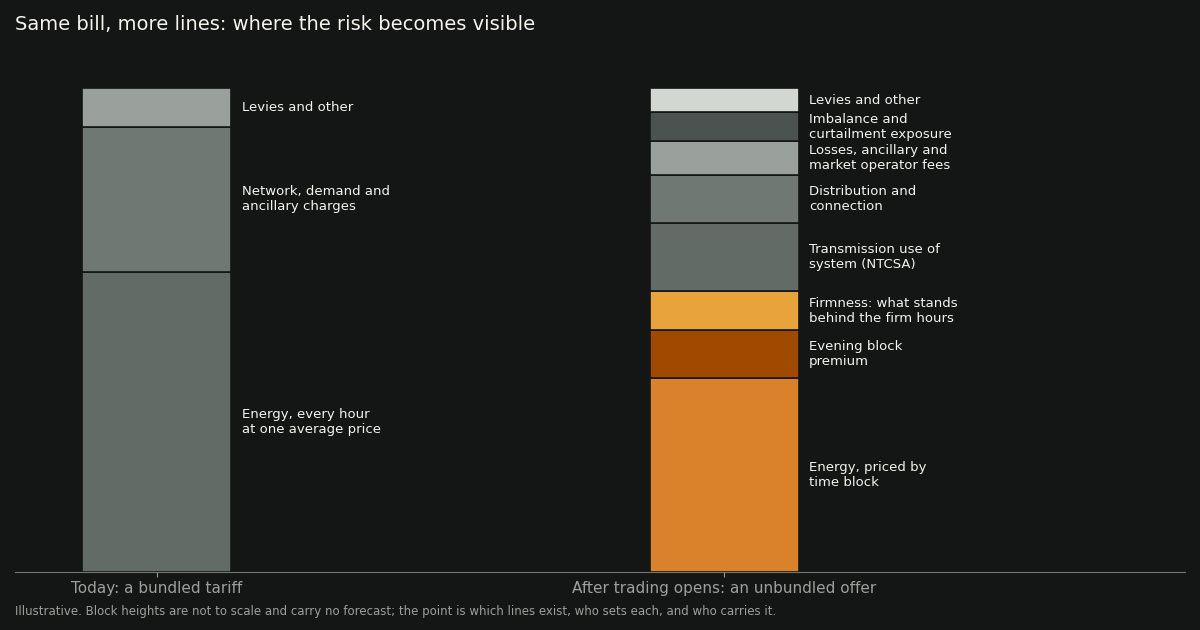
The offer you receive will have more lines than the bill it replaces, and every new line is a decision somebody has made about who carries a risk. Most of those decisions will have been made by the supplier. The questions below are how you take some of them back.
1. Which price is behind this number, and who chose it
Every offer will quote an energy price. The first thing to establish is whether it is a fixed number or a number that moves with the market, and if it moves, which market figure it follows. A contract indexed to the day-ahead average passes the whole distribution to you: the ordinary years and the tail. A fixed price keeps the distribution with the supplier, and the supplier will have charged for that. Neither is wrong. What is wrong is not knowing which one you have signed.
The distribution is the thing to hold in your head when you read the number. On the simulated prices we published last week, the median year in the first year of trading clears at roughly R410 per megawatt hour in today's money and rises to roughly R490 over the five years that follow, while the one year in ten rises from about R700 to about R930. The range is wide and its upper part grows faster than its centre. A fixed price sits somewhere in that range and the supplier chose where; an indexed price with no cap leaves the whole range with you. The question is which part of the range the quoted number sits in, who chose it, and whether your budget owner knows.
Ask: is the price fixed, indexed, or indexed with a cap or a collar; if indexed, to which published market figure, at what averaging period; and who in the supplier's organisation chose that reference and why.
2. Is the firmness physical or financial
"Firm" is the word that will do the most work in the first round of offers, and it has two meanings that look identical on paper and behave very differently at the site. Financial firmness means the supplier guarantees your price: if the market spikes, they pay the difference. Physical firmness means there is plant somewhere that will run for your hours, with a grid connection that carries it to you and fuel to keep it going. A financially firm contract can be honoured in full on a night your site goes dark, because the supplier owes you money, not megawatts.
The distinction matters more in a system where the quiet has come from a recovering coal fleet and nine gigawatts of rooftop solar than it would in a system with spare dispatchable plant. Ask what stands behind the firm hours: which plant, where, with what connection, on what fuel, and whether it already has a grid connection agreement or is still in a queue. Ask whether the supplier's obligation to you is to deliver energy or to settle a price. Ask what happens to your supply, not your invoice, when the plant behind the contract is on outage. If the answer to all three is a settlement formula, you have bought a price hedge rather than energy. Both are legitimate products with different failure modes, and the contract should say in plain words which one you hold.
3. What happens in the evening block
A mine, a mill, a data centre or any continuous process plant takes roughly the same energy at seven in the evening as at one in the afternoon. The market will not price those two hours the same, and the gap between them is the fastest growing line in the distribution we published. Rooftop solar has taken the midday load off the grid and left the evening peak untouched, and the plateau that growth is heading for means the shape is now a fixed feature of the system, not a transition.
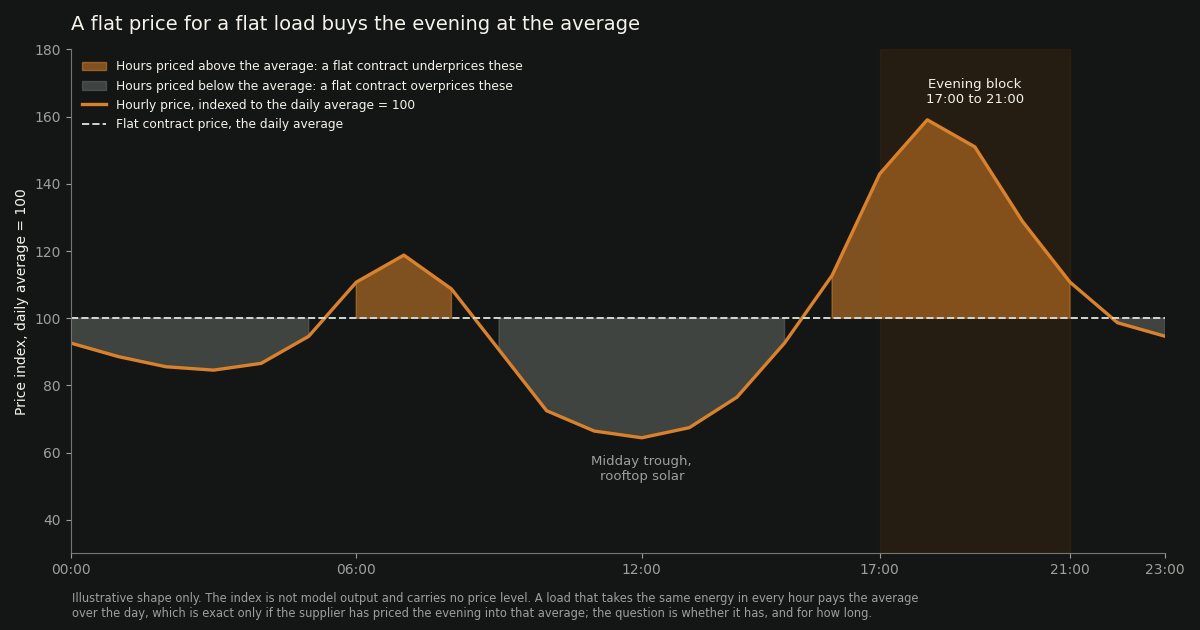
A flat energy price for a flat load is correct only if the supplier has priced the evening into the average and will keep doing so for the term. Ask for the price by time block, not just the headline. Ask which hours the offer treats as peak and whether that definition can change. Ask whether an evening premium, if there is one, is fixed for the term or reset each year against a market figure. And if your site has any flexibility at all, a crusher that can stop for two hours, a pump that can run at night, ask what the offer pays you for it, because in a shaped market a flat load is the most expensive kind to serve and the supplier knows it.
4. Which lines are pass-through, and who carries the regulator's next decision
Transmission use of system, distribution and connection charges, losses, ancillary services, the market operator's fees, and curtailment arrangements will each arrive as a line, and most of them are set by someone other than your supplier. The transmission company publishes its charges. The regulator approves them, usually once a year. A supplier who quotes an all-in price is doing one of two things: absorbing those changes and charging you for the privilege, or holding a clause that lets the price move when the regulator does. Find the clause.
Then read the change-in-law and the counterparty-change provisions as carefully as the price. The last year has shown both in action: the transmission company became a separate licensed company, the market operator was licensed, and the regulator moved existing independent power contracts to a new counterparty. Existing agreements are being re-read against the new structure. Ask which pass-through lines exist, who sets each one, how often it can change, whether the contract reopens when it does, and what happens if the licensed body on the other side of the wire is reorganised again during the term.
5. Who is on the other side, and what happens if they fail
The utility has been the counterparty to almost every large supply contract in the country, and its credit is the sovereign's. The market brings generators, traders and retailers whose balance sheets are their own, which is how a competitive market is meant to work, and it means a fixed price is only as good as the entity that promised it and the security that stands behind the promise.
Ask what security the supplier posts and what security it asks of you, in both directions. Ask what happens to your supply if the supplier defaults: whether there is a supplier of last resort, at what price, and whether you can step into the supplier's own contracts with the plant behind your firm hours. Ask who bears the cost of imbalance, the difference between what was contracted and what you actually used, and at what price that difference is settled. And ask for the termination provisions on both sides, because the clause that lets you leave a bad contract is worth more than most of the price negotiation.
Before the first offer arrives
None of this needs the market to be open. It needs five things that most large users do not have in one place today. Twelve months of half-hourly interval data for every supply point, so that you know your own shape before a supplier tells you what it costs. The share of your annual energy that falls in a four-hour evening block, which for a continuous process is close to a sixth and for a day-shift operation is much less. A named owner of the electricity number in the budget, who has seen the distribution it is drawn from. A view on which risks you want to carry and which you want to pay someone else to carry, decided before an offer frames the choice for you. And a position on term, which should follow the product rather than the calendar: for indexed energy, a short first contract with an option to extend costs little and preserves the right to learn; for physical firm hours, tenor is the price of having plant stand behind them, and the thing to negotiate is not the length but the step-in rights and the exit that come with it.
Market opening will produce a wave of offers, and the suppliers writing them will have spent longer thinking about the shape of your load than you have. The five questions close most of that gap. This piece is written for buyers. If a one-page version of the checklist would be useful for a procurement or energy meeting, message the page.