 Oshili Power
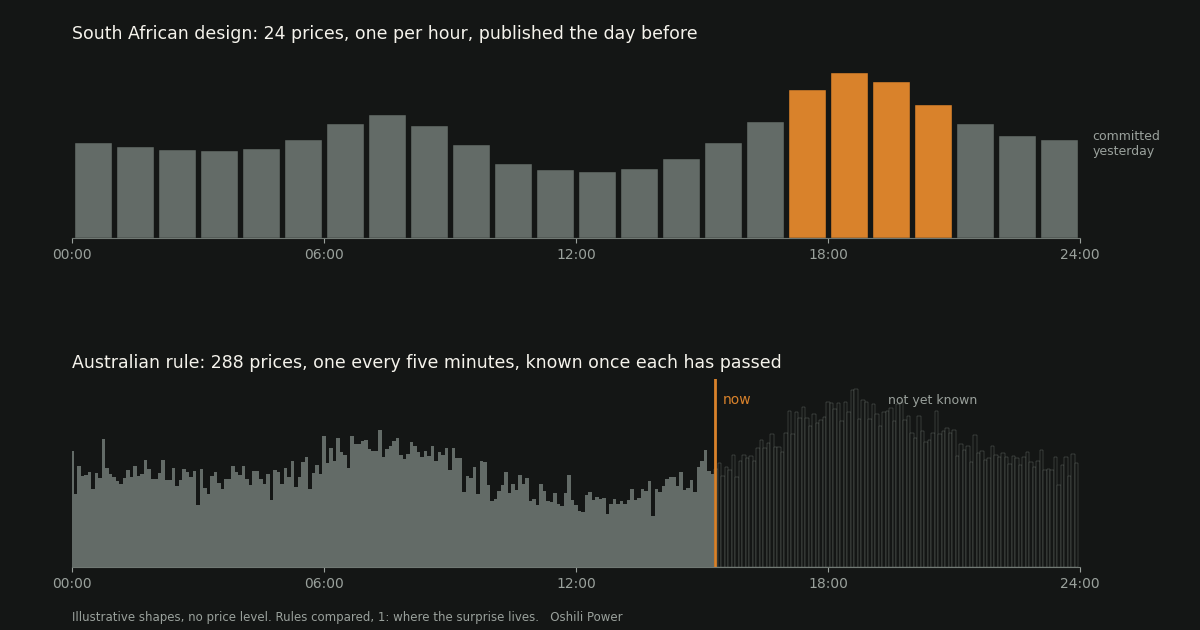
In Australia's National Electricity Market there is no day-ahead market. The spot price is set every five minutes as the system is dispatched, and has been settled on that basis since 1 October 2021, when the settlement period was shortened from thirty minutes to match the five-minute dispatch that has run since the market began. A buyer learns what an interval cost once it has passed, and works from the operator's forecasts until then.
The South African design runs the other way round. The market operator clears a day-ahead auction and publishes a price for every hour of the following day, with an intraday market to adjust positions during the day and a balancing process to settle the difference between what each participant committed and what actually flowed. Participants carry responsibility for their own balance: a position taken the day before is a position to be kept, or paid for.
What it means for a large user
For a mine, a mill or a continuous process plant the difference is practical rather than academic. Under the Australian rule the risk sits inside each five minutes: a site that cannot change its load in that window takes whatever the interval clears at, and its protection is a contract that fixes the price in advance. Under the South African rule the risk sits in the gap between tomorrow's commitment and tomorrow's reality. A load that is nominated flat and then runs flat has little to settle; a load that trips, or a site whose supplier under-nominated it, is exposed at the balancing price, which is where imbalance charges live.
Neither rule is kinder. The Australian design gives a buyer no commitment and no obligation to make one. The South African design gives a buyer a known price a day ahead and an obligation to be right about tomorrow. Same megawatt hour, a different place to be surprised, and a different thing to ask a supplier about: in one market, how is my price fixed; in the other, who carries the imbalance when my plant does not run to nomination.
One question for your supplier
Which would you rather manage: a price you learn afterwards, or a commitment you make the day before? And whichever market you are in, who carries the cost when your load does not match what was nominated?
Sources
- Australian Energy Market Operator, five-minute settlement commencement, 1 October 2021: settlement aligned to the five-minute dispatch period in force since the market's inception. VERIFIED.
- National Transmission Company South Africa, statement on its market operator role: day-ahead and intraday trading platforms, prices published for each hour of the following day, balancing, reconciliation and settlement, as reported in the trade press on its market operator licence application. VERIFIED as reported.
- Published summaries of the South African wholesale market design: participants act as balance responsible parties; intraday adjustment during the trading day. TRIANGULATED.
This note describes two market designs from their published documents. It is written for buyers. It states no view on prices and none on the merits of either design.