 Oshili Power
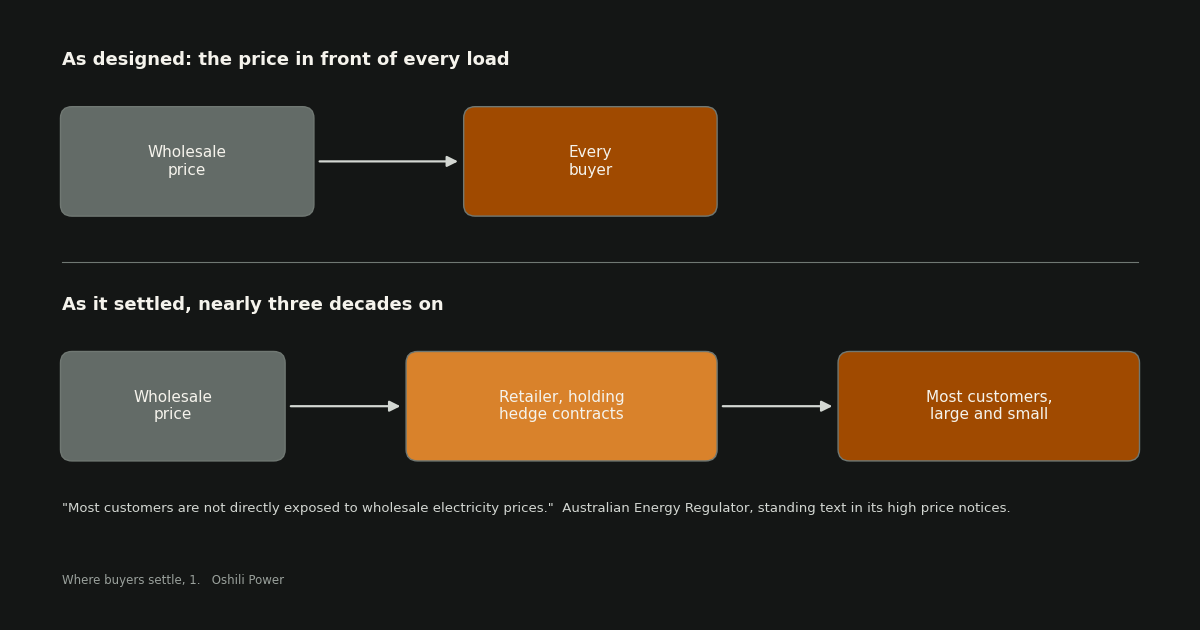
Australia's National Electricity Market began in December 1998 as an energy-only spot market, with the price set by the operator's dispatch and every buyer, in principle, free to face it. Nearly three decades on, the regulator's standing description of the market, repeated in its notices whenever the spot price spikes, is this: most customers are not directly exposed to wholesale electricity prices; retailers are the main purchasers in the wholesale market; they bundle electricity with network services for sale to residential, commercial and industrial customers; and they manage their exposure with hedge contracts that lock in firm prices for the electricity they intend to buy.
What happened
A market built to put the price in front of every buyer ended with an intermediary and a contract in front of almost every load. That is not a failure of the market; the price is still set every five minutes and still disciplines generators. It is what buyers chose once they had seen the price move: the first few spikes taught most of them that the value of a known number exceeded the value of the occasional cheap afternoon, and they paid someone to stand between them and the rest. The large users who stayed closest to the price were the ones with load they could move, and they were paid for moving it.
What it means for a South African buyer
The question for a South African buyer is not whether the wholesale market will offer exposure; the design does that by construction. It is how much of the exposure you will decide to keep, and who will stand between you and the rest. Those are two separate choices. The first depends on your load: continuous processes settle differently from day-shift operations, and sites with flexibility have something to sell. The second depends on the market: whether a licensed trader or retailer with its own balance sheet is prepared to carry your tail, on what security, and for how long.
The Australian answer took the better part of a decade to settle. The South African market will have the benefit of watching that history, and the disadvantage of starting without a deep market in the contracts that made the intermediary model work.
One question for your own site
What share of your load would you leave at the wholesale price if the choice were yours, and what would it take, in information and in flexibility, to make that share larger?
Sources
- Australian Energy Regulator, high price event notices (standing text, for example AC 197/19 and AC 13/20), and the retail chapters of the State of the Energy Market reports 2022 to 2024: most customers not directly exposed; retailers the main purchasers; bundling; hedge contracts. VERIFIED.
- Australian Energy Market Operator, five-minute settlement commencement page: the market's inception in 1998. VERIFIED.
- The reading that buyers chose intermediaries after seeing the price move is the author's interpretation of the regulator's description. DEDUCED.
This note describes a market outcome from the regulator's published words. It is written for buyers. It states no view on prices and names no product.